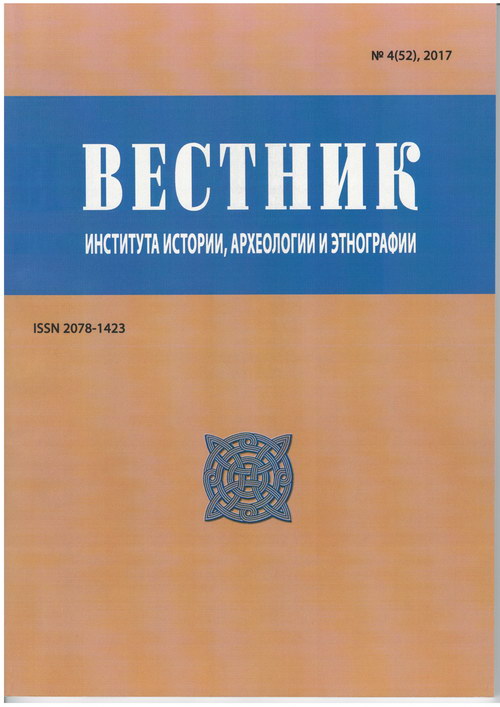
SYMMETRY AND ASYMMETRY IN FORMS AND DECORATIVE FINISH OF MUSLIM GRAVESTONES OF THE 14th -15th CENTURIES IN THE VILLAGE OF KUBACHI
DOI:
https://doi.org/10.32653/CH13454-73Keywords:
village of Kubachi, Muslim headstones, decorative finish, Late Cufic Arabic inscriptions, ornament, symmetry principleAbstract
This article is sequel to the article published in the third issue of the Journal “Herald of the Institute of History, Archeology and Ethnography of the Dagestan Scientific Center of the Russian Academy of Sciences” in 2017 and it deals with the peculiarities of decorative finish of Muslim gravestones of the 14th -15th centuries in the village of Kubachi, partly in the village of Ashty, and now uninhabited villages of Dats’amazhe and Kalakoreish. This article, unlike the previous one, covers the issues related to the principles and methods used by stonecutters, calligraphers and ornamentalists in the decoration of the headstones. The analysis shows that bilateral symmetry was the guiding principle, which stonecutters used in decorative finish of the gravestones and of various architectural details as well. It is noted that the patterned and epigraphic compositions presented on the medieval headstones are based on the principle of free or relative symmetry, since there is no exact coincidence of the left and right sides of the figures. Along with the compositions with bilateral relative symmetries, there are the so-called mirror symmetries, in which the left and right sides are the same and coincide. These are mainly compositions of floral ornament. In medieval stone-cutting art of the village of Kubachi, mirror symmetry is most often found in heraldic compositions with images of paired, opposing animals, birds and fantastic creatures carved on various architectural details. The stonecutters adhered to the principle of relative (free) symmetry while making relief decorative Arabic inscriptions against the background of the floral ornament. The same inscription of the patterned and epigraphic band (border) in the upper part of many headstones is divided into two equal parts by a small ornamental medallion or braided ornament. But according to the figure (structure) these parts (right and left) are different. The stonecutters were to show the symmetry of the whole decoration of the headstones - the center and its sides. Among the architectural details there are also some decorative Arabic inscriptions executed in compliance with bilateral mirror symmetry. This symmetry is presented in the inscription (pseudo-inscription) on the archivolt of the window tympan of late 14th - early 15th centuries with the image of a horse rider, and on the archivolt of the window tympan with the image of a deer dropped down to the front legs. The author of the article presents the data on the relationship between Kubachi and the neighboring villages of Itsari, Shiri, Dats’amazhe in the development of the stone-cutting art and other types of decorative and applied art - wood carving, metalworking, carpet weaving, etc. in terms of similarity of compositional techniques and ornamental motives, performed in compliance with the principle of symmetry. The author analyzes similarities and differences in the decoration of the headstones at the medieval cemeteries of the village of Kubachi - “Bidaq huppe”, “Ts’itsila”, “Baqutsila”, “Dats’amazhe”, and also in the villages of Ashty and Kalakoreish. The modern ornamental art of Kubachi has inherited the rhythm, symmetry, balance, and proportionality peculiar to medieval ornamental compositions.Downloads
References
Алиханов Р.А. Кубачинский орнамент. Альбом. М.: Госиздат лит-ры по бытовому обслуживанию населения, 1963. - 13 с., 40 табл. илл.
Ахраров И.А., Ремпель Л.И. Резной штук Афрасиаба. Ташкент: Изд-во литературы и искусства им. Гафура Гуляма, 1971. - 160 с.
Вейль Герман. Симметрия / Перев. с англ. М.: Наука, 1968. - 191 с.
Воронина В.А. Архитектурный орнамент Средней Азии // Архитектурное наследство. Вып. 37. М.: Стройиздат, 1990. С. 199-208.
Гамзатова П.Р. Архаические традиции в народном декоративно-прикладном искусстве (к проблеме культурного архетипа). М.: Изд-во Едиториал УРСС, 2004. - 144 с.
Дебиров П.М. История орнамента Дагестана. Возникновение и развитие основных мотивов. М.: Наука, 2001. - 416 с.
Иванов А.А. О датировке кубачинских памятников // Искусство Кубачи. Альбом / Сост. А.А. Иванов. Л.: Художник РСФСР, 1976. С. 164-207.
Иванов А.А. Кубачинский бронзовый котел XIV в. // Сообщения Государственного Эрмитажа (Далее - СГЭ). Вып. XLII. Л., 1977. С. 54-58.
Иванов А.А. Новое чтение надписи на тимпане с борцами из селения Кубачи // ЭВ. Вып. XXII. Л., 1984. С. 57-60. Рис. на с. 58.
Иванов А.А. Персидские надписи из Кубачи // Rivista studi orientali. Vol. LIX. Fasc. I-IV. Roma, 1987. C. 213-224. (статья на рус. яз.).
Избакаров Г.Б. Основы кубачинского искусства. Издание 2-е, дополненное. Махачкала: Дагучпедгиз, 1992. - 128 с.
Искусство Кубачи. Альбом / Сост. А.А. Иванов. Л.: Художник РСФСР, 1976. - 208 с., 136 илл.
Кильчевская Э.В. Декоративное искусство аула Кубачи. М.: Госиздат местной промышленности и художественных промыслов РСФСР, 1962. - 82 с., 16 табл. илл.
Кильчевская Э.В., Иванов А.С. Художественные промыслы Дагестана. М.: Всесоюзное кооперативное издательство, 1959. - 176 с.
Крачковская В.А. Арабские надгробия Музея палеографии Академии наук СССР. Л.: Изд-во АН СССР, 1929. - 125 с.
Лелеков Л.А. Искусство Древней Руси и Восток. М.: Советский художник, 1978. - 159 с.
Макарова Т.И. Орнамент Древней Руси. Методика изучения орнамента // Древняя Русь. Быт и культура. М.: Наука, 1997. С. 203-207.
Магомедов М.Г., Шихсаидов А.Р. Калакорейш (крепость курейшитов). Махачкала: Юпитер, 2000. - 168 с.
Маммаев М.М. Искусство Зирихгерана-Кубачи XIII-XV вв. и его место в системе художественных культур Востока и Запада. Махачкала: Изд-во «Эпоха», 2014. - 592 с.
Маммаев М.М. Композиционные приемы и орнаментация средневековых азербайджанских и дагестанских ковров в декоре некоторых памятников камнерезного искусства Дагестана XIV-XV вв. // Вестник Института истории, археологии и этнографии. 2016. № 4. С. 108-126.
Маммаев М.М. Мусульманские надмогильные памятники XIV-XV вв. из с. Кубачи: Особенности декоративной отделки // Вестник Института истории, археологии и этнографии ДНЦ РАН. 2017. № 3. С. 77-99.
Маммаев М.М. Гаджиомар Изабакаров - ювелир, художник, педагог // Гаджиомар Изабакаров - ювелир, художник, педагог. Махачкала: Издательский дом «Дагестан», 2016. С. 8-23.
Маммаев М.М., Миркиев Г.М. Изучение памятников камнерезного искусства и арабской эпиграфики XIII-XX вв. Кубачино-даргинского нагорья Дагестана в 2009 г. // Вестник Института истории, археологии и этнографии. 2009. № 4. С. 120-147.
Шихсаидов А.Р. Эпиграфические памятники Дагестана X-XVII вв. как исторический источник. М.: Наука, 1984. - 464 с.
Шубников А.В., Копцик В.А. Симметрия в науке и искусстве. Издание 2-е, перераб. и доп. М.: Наука, 1972. - 339 с.
Эпиграфические памятники Северного Кавказа на арабском, персидском и турецком языках. Часть 1. Надписи X-XII вв. / Текст, переводы, комментарии, введение и примечания Л.И. Лаврова. М.: Наука, 1966. - 300 с.
Downloads
Published
Issue
Section
License
All the Copyright statements for authors are present in the standart Publishing Agreement (Public Offer) to Publish an Article in an Academic Periodical 'History, Archeology and Ethnography of the Caucasus'.
Standart Publishing Agreement (Public Offer) to Publish an Article in an Academic Periodical
''History, Archeology and Ethnography of the Caucasus'
The Institute of History, Archeology and Ethnography of the Dagestan Scientific Centre of Russian Academy of Sciences, hereinafter referred to as the Publisher, on the one hand, hereby offers to the public at large, hereinafter referred to as the Author, on the other hand, hereinafter collectively referred to as the Parties, to enter into this agreement, hereinafter referred to as the Agreement, regarding publication of scholarly materials, hereinafter referred to as the Article, in the Journal named 'History, Archeology and Ethnography of the Caucasus’, hereinafter referred to as the Journal, under the following terms.
- General Terms and Conditions
1.1. Pursuant to Clause 2 of the Article 437 of the Russian Federation Civil Code, this Agreement shall be recognized as the public offer, hereinafter referred to as the Offer. Subject to Article 438 of the Russian Federation Civil Code, this Offer shall be deemed to have been completely and irrevocably accepted after the Author had submitted his/her materials by uploading those onto the network electronic system of the article acquisition for review available at the respective section of the Journal's site at URL: http://www.caucasushistory.ru on the Information and Communication Network known as the Internet, hereinafter referred to as the Internet.
1.2. Pursuant to the Russian Federation effective law as applicable to compliance with the copyright to electronic information resources, no materials from any site, electronic journal or project may be reproduced, in whole or in part, in any form, either in a hard or soft copy, without a prior consent from the Journal's authors and editorial staff, which may be expressed by posting a respective consent (open license Creative Commons Attribution International 4.0 CC-BY) in the relevant section of the Journal's site on the Internet.
Whenever any published materials are used within the context of other documents, a reference to the original source needs to be specified.
1.3. The Journal is registered by the Federal Oversight Service for Communications, Information Technologies and Mass Communications (RosKomNadzor).
- Terms Used in This Agreement
The Author is an individual (or individuals) whose creative labor has produced the Article.
The Offer Acceptance means a complete and irrevocable acceptance of the Offer under the terms specified in Clause 3 hereof (the Author accepts the Offer by submitting an application to the Publisher, i.e. by uploading the Article along with support materials onto the network electronic system of the article acquisition for review available at the respective section of the Journal's site at URL: http://www.caucasushistory.ru on the Internet).
The Journal means an academic periodical named ' History, Archeology and Ethnography of the Caucasus.
The Application means an electronic request of the Author addressed to the Publisher for publishing the Article in the Journal by uploading the Article and support materials onto the network electronic system of the article acquisition for review available at the relevant section of the Journal's site at URL: http://www.caucasushistory.ru on the Internet).
The Publisher is The Institute of History, Archeology and Ethnography of the Dagestan Scientific Centre of Russian Academy of Sciences, being the Journal's founder and publisher.
The Article's Metadata means any materials in Russian and English intended to be included into the Science Citation database as per the original version of the Article such as the Article title; authors' details (full last name, first name, patronymic, present employer of each author with indication of the postal code, contact details (e-mail) of each author; abstract; keywords; topical classifications: UDC or any other bibliographic and library classification, and subject indices; bibliography (list of references).
The Offer means this document (offer to the Author) to publish an Article by uploading it onto the site at URL: http://www.caucasushistory.ru on the Internet.
The Publication means the act of publishing the Article in the Journal.
The Journal's Editorial Staff means a creative team engaged in preparing the Journal for publication.
The Editorial Board is an advisory body of the Journal's Editorial Office.
The Article means a result of fundamental and applied scholarly efforts in the form of a scholarly material, scientific review material, scientific message, bibliographical review on specific topics of the scholarly study, and background information on Russian and foreign scientists submitted by the Author for publication in the Journal.
The Parties mean the Author and the Publisher.
The Article Requirements mean requirements to the materials published in the Journal's section named "To Authors" of the Journal's site at URL: http://www.caucasushistory.ru on the Internet.
The Service means publication of the Article in the Journal as per the Author's application.
- Subject Matter of the Agreement (Offer)
3.1. Subject to this Agreement, the Author shall provide the Publisher at no expense for the copyright duration as stated by the Russian Federation legislation with a non-exclusive license for use of the Author-created Article for the purpose of its publication in the Journal.
3.2. The rights to use this Article as assigned hereunder shall include but not limited to:
- reproduction of the Article or any part thereof, as well as its metadata in Russian and English in any material form whatsoever, including soft and hard copy forms, as an individual work product in periodicals and/or databases (whether local or web-based) owned by the Publisher and/or any other persons at the discretion of the Publisher;
- dissemination of the Article or any part thereof, as well as its metadata in Russian and English on any media as part of the Journal and/or databases owned by the Publisher or any other persons, at the discretion of the Publisher, or as an individual work product, worldwide via open access or by subscription without payment of any fee to the Author;
- making public the Article or any part thereof as well as its metadata in Russian and English so that any person could access the Article from any location and at any time of his/her choice (including via the Internet);
- issuing permissions to use the Article or any part thereof as well as its metadata in Russian and English to any third parties while notifying the Author by publishing the respective information on the Journal's site without payment of any fee to the Author;
- processing, including translation of the Article (including translation into foreign languages), and use of the processed (translated) Article in any manner specified above;
- any other rights, not expressly assigned to the Publisher hereunder, including patent rights to any processes, techniques or methods, and other means, described by the Author in the Article, as well as trademark rights, shall be retained by the Author.
3.3. No territorial restrictions will be applied to the use of rights to the Article.
3.4. This Agreement shall become effective from the time the Article is submitted to the Journal, i.e. uploaded along with support materials onto the network electronic system of the article acquisition for review available at the relevant section of the Journal's site at URL: http://www.caucasushistory.ru on the Internet, hereinafter referred to as the Article Upload.
3.5. The rights shall be assigned by the Author to the Publisher at no expense, and the Article publication in the Journal shall not result in any financial contribution to the Author.
3.6. If the Publisher decides to refuse to publish the Article in the Journal, this Agreement shall cease to be in force. A decision to refuse publication shall be sent to the Author via the e-mail address specified in the Application.
3.7. The Publisher undertakes, throughout the currency of this Agreement, to provide to the Author the services associated with publication of the Article on the Journal's site at URL: http://www.caucasushistory.ru on the Internet.
- General Terms of the Services Provision
4.1. The Publisher shall provide the services to the Author only if:
- the Author submits all materials compliant with the Offer requirements by way of the Article Upload;
- the Author Accepts the Offer.
4.2. The services shall be provided to the Author free of charge.
4.3. If any materials submitted by the Author are found in breach of rules and requirements of this Offer, the Publisher shall have a right to refuse to publish those.
4.4. The Publisher shall not be responsible for any third-party unauthorized use of the data provided by the Author during the currency of this Agreement.
- Rights and Responsibilities of the Parties
5.1. The Author warrants that:
- he/she is the valid holder of exclusive rights to the Article; rights granted to the Publisher hereunder were not earlier assigned and will not be assigned to any third parties prior to publication of the Article by the Publisher in the Journal;
- the Article contains all the references to cited authors and/or sources (materials) that are required by the effective copyright law;
- the Author has obtained all required licenses to results, facts and other borrowed materials used in the Article where the Author is not a copyright holder;
- the Article does not contain any materials that may not be published in public sources in accordance with the effective Russian Federation statutory instruments, and the Article publication and dissemination will not involve any disclosure of classified (confidential) information, including state secrets;
- the Author has advised other Co-authors of the terms of this Agreement and has received consents from all the Co-authors to conclude this Agreement under the terms hereunder.
5.2. The Author undertakes to:
- submit a manuscript of the Article as per the Requirements to articles;
- avoid using the soft copy of the Article produced by the Publisher for commercial purposes and in other periodicals;
- while preparing the Article for publication, the Author undertakes to:
- a) make edits specified by readers and approved by the Journal's Editorial Office in the text of the Article and/or revise the Article following the Publisher's request, where necessary;
- b) proofread the Article within the timeframes specified in the Journal publication schedule;
- c) make only such edits in the proof that are minimally required to correct errors made in the Article original and/or introduce factual and momentary changes.
5.3. The Author is entitled to: pass to
- any third party a soft copy of the published Article provided by the Publisher pursuant to Clause 5.4 hereof for the Article to be incorporated, in whole or in part, into a scientific information database or repository in order to promote academic or scholarly investigations or for informational and educational purposes subject to the Author, Journal and Publisher being properly referenced.
5.4. The Publisher undertakes to:
- publish the Author's Article, in soft or hard copy form, in the Journal in accordance with the terms hereof;
- provide the Author with the proof of the Article and make reasonable edits as requested by the Author, where required, following the Journal's Editorial resolution;
- provide the Author with the soft copy of the published Article by sending it to the Author's e-mail address within 15 business days of the Journal issue's publication;
- respect the Author's rights established by the effective law, protect those and use best endeavors to prevent any copyright infringements by third parties.
5.5. The Publisher is entitled to:
- carry out technical and literary editing of the Article such that its basic content would remain unchanged;
- review the Article and suggest appropriate changes to the Author, and elect not to publish the Article if the Author fails to introduce such changes;
- require from the Author and/or other persons that the Journal, Publisher, Author and any other copyright holder, as well as the title of the Article, Journal issue identification and a year of publication as specified in the Journal be properly referenced whenever the Journal and/or the Article, including any individual part or fragment thereof, are used by any of the above-mentioned individuals thereafter;
- publish preliminary and/or advertising information on the forthcoming publication of the Article in mass media and any other information sources;
- establish rules (conditions) for acceptance and publication of materials in the Journal. The Journal's Editorial Board, headed by the Editor-in-Chief, shall enjoy an exclusive right to accept and/or reject any materials submitted to the Journal's Editorial Office for publication purposes. No manuscript (tangible medium) submitted by the Author to the Journal's Editorial Office will be subject to return. The Journal's Editorial Staff will not enter into any correspondence regarding the rejection of the Article by the Journal's Editorial Board;
- suspend provision of services to the Author hereunder temporarily for technical, technological and other reasons preventing the services from being provided for the duration of remedial activities;
- suspend services hereunder in accordance with civil procedures if:
- a) the Article does not correspond to the topics covered by the Journal or by any part thereof, or the submitted material is found insufficient for the individual publication, or the Article design is found at variance with the requirements imposed;
- b) the Author is in breach of any other obligations assumed under the Offer arrangement;
- introduce changes to the Offer as per the procedure established by the Offer.
5.6. Unless otherwise provided or stated herein, the Parties shall refer to the effective legislation of the Russian Federation.
- Offer Acceptance and Conclusion of the Agreement. The Term of the Agreement
6.1. This Agreement shall become effective when concluded, i.e. when the Author Accepts the Offer by sending an application to the Publisher, that is, by uploading the Article (Article Upload), and remain in effect for five years.
6.2. The Offer Acceptance constitutes an Agreement made in writing (Articles 438 and 1286.1 of the Russian Federation Civil Code) under the Offer terms.
6.3. Unless any of the Parties sends to the other Party a written notification of the Agreement termination no later than two months prior to the end of the specified five-year period, the duration of the Publisher's copyright to the Work shall be automatically extended by the similar period. The number of extensions is not limited.
6.4. The term of the Agreement may not exceed the duration of exclusive rights to the Article pursuant to the Russian Federation legislation.
6.5. Whenever the Author assigns (disposes of) its exclusive rights to the Work to any third party, this Agreement shall remain in effect.
- Agreement Modification and Termination Procedure
7.1. The Publisher shall have a right to unilaterally modify the terms of this Agreement by giving a prior notice to the Author, at least ten (10) calendar days before such modifications become effective, to the Author's e-mail address specified in the Author's application or via the Journal's site. These modifications shall become effective from the date specified in the respective notice.
7.2. If the Author disagrees with any modification in the terms of this Agreement, the Author shall have a right to submit a written notice of his/her withdrawal from this Agreement by uploading it onto the network electronic system of the article acquisition for review, available at the relevant section of the Journal's site at URL: http://www.caucasushistory.ru on the Internet.
7.3. This Agreement may be terminated early:
- at any time by mutual agreement of the Parties; or
- otherwise as stipulated herein.
7.4. The Author shall have a right to cancel this Agreement unilaterally by sending the Publisher a respective notice in writing at least sixty (60) calendar days prior to the intended date of the Author's Article publication in the Journal.
7.5. The termination of this Agreement for any reasons shall not release the Parties from responsibility for breach of any Agreement terms during the currency hereof.
- Liability
8.1. A Party which has failed to perform its obligations under this Agreement, either in full or in part, shall be held liable pursuant to the Russian Federation legislation in force.
8.2. All the data provided by the Author shall be trustworthy. The Author shall be responsible for completeness and reliability of the data provided to the Publisher. The use of untrustworthy information obtained from the Author shall not entail any responsibility upon the Publisher for any adverse effects resulting from its actions based on such untrustworthy information.
8.3. The Author shall take full personal responsibility for compliance with the requirements of the Russian Federation law on advertising, protection of copyright and related rights, protection of trademarks and service marks, and protection of consumer rights.
8.4. The Publisher shall not be held responsible hereunder for:
- any actions resulting directly or indirectly from the actions of the Author;
- any loss incurred by the Author whether or not the Publisher was in a position to predict such loss.
8.5. The Publisher shall be relieved from any responsibility for non-compliance with the terms of this Agreement if such non-compliance is a result of a force-majeure event such as an act of state authorities, including adoption of legal instruments, fire, flood, earthquake, other natural calamities, loss of power and/or computer network failure, strikes, civil commotions, riots, and any other similar events.
- Dispute Resolution Procedure
9.1. Any disputes and disagreements shall be resolved by the Parties by negotiations, and if the Parties fail to reach an agreement, these shall be resolved in accordance with the effective law of the Russian Federation.
9.2. If any disagreements remain unresolved, the Parties shall settle those at the location of the Publisher in accordance with the effective law of the Russian Federation.
- Miscellaneous
10.1. Any notifications, messages, requests etc., excluding documents which need to be forwarded in original form pursuant to the Russian Federation legislation, shall be deemed to have been received by the Author, if delivered (sent) by the Publisher via the Journal's site, including by publishing those, by fax or e-mail specified in the Application, or using other communication facilities. The Parties acknowledge validity of notifications, messages, requests etc. delivered (sent) using the above-listed methods.
10.2. Where the Publisher becomes subject to any claims related to non-compliance with an exclusive copyright or other intellectual property right of any third party during the writing of the Article or in connection with conclusion of this Agreement by the Author, the Author undertakes to:
- immediately upon receipt of a Publisher's notification, take measures to settle disputes with such third party, and, where necessary, join the litigation in favor of the Publisher and use its best endeavors to exclude the Publisher from the defendants;
- reimburse the legal cost, expenses and loss incurred by the Publisher as a result of application of a pre-award relief and measures for execution of a judgment, and damages paid by the Publisher to any third party for the infringement of exclusive copyright and/or other intellectual property rights, as well as other expenditures incurred by the Publisher as a result of infringement by the Author of any warranties provided hereunder.
10.3. Subject to Article 6 of the Federal Law On Personal Data No. 152-FZ dated July 27, 2006, for the period from the conclusion of this Agreement and until the discharge of Parties obligations hereunder, the Author expresses his/her consent to processing of the following personal data by the Publisher: last name, first name, patronymic; taxpayers identification number (TIN); place and date of birth; citizenship details; ID document details; registration and actual location address; e-mail address; mailing address with postal code; contact phone numbers; fax numbers; and details of the employers.
10.4. The Publisher is entitled to process the above personal data for the purpose of this Agreement performance, including for provision of information and reference services to the Author. The processing of personal data shall be understood to mean any handing (operations) with personal data, including collection, systematization, accumulation, storage, refinement (update, alteration), use, distribution (including transfer to third parties), depersonalization, blocking and deletion of personal data in accordance with the effective Russian Federation legislation.
10.5. Where permitted by the Russian Federation legislation, the Author is entitled to withdraw his/her consent to processing of personal data as listed in Clause 10.3 by forwarding a respective notice to the Publisher. Upon receipt of such notice, the Publisher has a right to suspend services.
10.6. The Author will, on a goodwill basis, submit his/her details (and details of each Co-Author subject to their prior consent) to the Journal's Editorial Office consisting of his/her: last name, first name, patronymic, academic rank, academic degree, job title, employer details (name and mailing address), work phone number and e-mail address for the purpose of its general publication in the Journal along with the Article.
- Registered Address and Particulars of the Publisher
The Institute of History, Archeology and Ethnography of the Dagestan Scientific Centre of Russian Academy of Sciences.
Address: M. Yaragskogo st. 75, Makhachkala, Republic of Daghestan, 367030, Russian Federation.
Tel./fax: +7 (872) 262-4571, +7 (872) 262-9097
E-mail: caucasushistory@yandex.ru